This will store a cookie for your name, and a unique
identifier which will both be used on the server for the
duration of any games you play. Privacy.
Remove player
This will remove player from the game and they will be unable to rejoin. Only the host is able to remove players.
Remove spectator
This will remove spectator from the game. Only the host is able to remove spectators.
Leave the game
This will forfeit the current game, and you will be unable to rejoin.
Reset the game
This will reset the game for everbody. Use this if
you started the game before all players arrived, or in
case of any other problems that mean the game cannot
continue.
If you would like to start a new game, there
is a link to a randomly generated room below. Click the
clipboard icon to copy the link for pasting to your
friends.
If you have been given a room link, follow that
directly to join the room. Note that you can't join a game that
is already in progress.
As with many games, explaining the rules can seem pretty
complicated. This isn't a difficult game though, so either
read the below or pick it up as you go along, assuming you're
playing with experienced players.
Every player starts with five dice. The aim of the game is
to be the last player with any dice. The game consists of a
number of rounds where players can only see their own dice, and
take turns to make calls predicting what dice are present.
The full instructions begin below, but if you can also see an example game.
Starting the game
When you join a room that has not got a game playing, you
will see all of the current players. Your player has a blue
border as shown. The arrow indicates the direction of play.
Your name here ⇨
The host (indicated by the lightning bolt) should wait until
all players are present, then press . The host
also has the ability to change game settings before the game starts
- see the cog, or to remove players at any time by clicking on
them.
The first round
All players should click the
to roll a single dice. The player with the highest value
becomes the first player to make a call. If there is a draw,
keep rolling until there is a winner. The starter for each
round is highlighted in green. Once the starter is decided,
click
again to receive your dice.
Starter ⇨
The call (which is made through the video/audio call) should
be of the form "four fives", which means "I predict that there
are at least four dice on the table that have five spots
showing". The next player (indicated by the arrows) has to
either make a larger call, or call Dudo ("I doubt").
For the first call, it is not allowed to start with a dice
value of one, because ones are special in most cases (explained
below). This means the lowest value starting call is "one
two".
The player above may wish to consider a call of "threes", or
they may decide to bluff about what dice they have.
Increasing the call
To make a larger call, the next player has to either
increase the quantity of dice to increase the dice value, or
even both. If you increase the quantity of dice then it is
allowed to decrease the dice value. By making a larger call,
the player accepts the call of the previous player, and play
moves on to the next player who then either raises the call, or
calls Dudo.
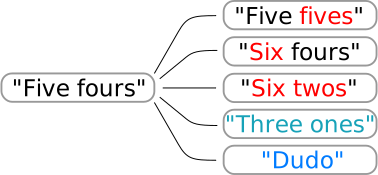
The diagram below shows some example possible calls,
assuming a first call of "five fours". The first option "five
fives" increases the dice value only. The second example, "six
fours" increases the dice quantity but leaves the dice value
unchanged. The third example, "six twos", increases the dice
quantity and takes the opportunity to reduce the dice value. It
is perfectly acceptable to make bigger jumps, so a call of
"eight sixes" in this case may be bold, but is allowed.
The remaining two options are explained in the sections
below.
Ones are wildcards
For most of the game, the dice value of one can be used as a
wildcard value which matches with all other dice values. This
means that a call of "five fours" actually means all dice
values that are either four or one. With 25 dice, you would
expect there to be approximately eight of each value from two
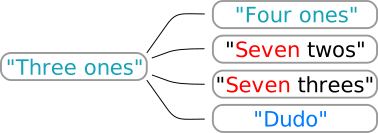
to six. When making a new call, it is possible to change from
using the regular dice values of two to six, to calling "ones"
instead. This is shown in the fourth option in the diagram
above. When a call with ones is made, the quantity of dice
called must be halved and rounded up if necessary. So a call of
"four fives" could be followed by a call of "two ones", or a
call of "five sixes" could be followed by a call of "three
ones".
When a call of ones is made, it is only the dice with
ones showing that count.
It is also possible to respond to a call of "ones" by
changing back to a call of dice values two to six. To do this,
the quantity of dice called must be doubled, plus one.
So a call of "two ones" could be followed by a call
of "five threes", but not "four threes". A call of "six ones"
could be followed by a call of "thirteen twos".
The player starting a round is not allowed to have their
first call be "ones".
Calling Dudo
When the player that is due to make the next call does not
believe the previous players call, they should say Dudo, and
click on the
button. This will result in all dice being shown player by player,
starting with the player that called Dudo. Once
all dice are shown, the relevant dice values (including ones or
not, depending on the call) should be counted up to see whether
the call was correct. If the call is correct - there were at
least as many dice with the called dice value - then the player
who called Dudo lost. If there were not enough dice, the
playing making the call lost. After determining which player
lost, they should press the
button. The losing player has a dice taken away from them
If you press the Loser button when you didn't mean to, don't
worry, the Loser button transforms into an
which you can use to go back and let the other player press the
loser button.
The next round
The player who lost their dice starts the next round, unless
they lost their final dice, in which case the player after them
starts. Each player clicks "Roll" to get their new dice.
Palifico
When a player loses their fourth dice, i.e. they have a
single dice left for the first time, it is a special round called
Palifico. In this round, ones do not count as wild, and the
starting player can start by calling ones if they wish. After
the first call, the dice value cannot change. So if the first
player calls "one one", the second player could call "two
ones", but not "one two". The round then continues as
normal.
A player who is "ex-Palifico", i.e. lost their fourth dice
but has survived to later rounds, has a special ability in any
later Palifico rounds they take part in. An ex-Palifico player
can increase the dice value, but without decreasing the dice
quantity. So if the call is "one one", an ex-Palifico player
may call "one two". But if the call was "one six", then the
ex-Palifico player has no choice but to call "two sixes", or
call Dudo, because they are not allowed to reduce the dice
value.
When there are only two players remaining Palifico rounds do
not apply.
Calza
If at some point in a round, you decide that the call that
has just been made is exactly correct, and you are neither the
person making the call nor the person who has to make the next
call, then you can say "Calza" and click the
button. At this point, the dice are shown and counted up as
normal. If the call was exactly right, i.e. for a call of "five
fives" there must be exactly five fives, including wildcards,
then you won the call and should click the
button.
You will win a dice back, up to a maximum of five dice. If there were six
fives, then you lost, should click the
button, and forfeit a dice.
Calling Calza on a Palifico round is not allowed, nor if
there are only two players in a round.
Winning the game
If you are the last player to have any dice remaining,
congratulations you won!
Leaving the game early
If you need to leave the game before it is complete, use the
menu button top right to access the
button, which is only available at the beginning of a round.
You will be asked to confirm your decision. When you leave the
game your player and dice will be removed and play can
continue as before. It is not possible to rejoin a game after
leaving.
If you are in a game that has not yet started, simply closing the page is enough to leave the game.
Example game
This section shows a full example game between three
players. For simplicity, each player only has three dice to
start with. The game plays exactly the same with the normal
five dice. We are playing as the player Roger.
Roll to start
The first rolls are to find the starter. Everybody rolls... and Alice wins.
Bob ⇨
Alice ⇨
Roger ⇨
Round one
Everybody rolls again to receive their first game dice.
There are a total of 9 dice, each with 6 sides. That means each
number will appear on average 9/6 = 1.5 times total. On normal
rounds, dice with a value of 1 count as a wildcard, so
including them in our count means each number 2-5 will appear
on average 3 times total.
Bob ⇨
Alice ⇨
Roger ⇨
Alice makes the first call: two fives.
Roger's hand already has two fives, the one and the five, so
he cannot call Alice a liar. There are two obvious choices: go
to three fives (which is still a plausible call), or go to one
one. When moving from a dice value of 2-5 to a value of 1, the
quantity of dice always has to halve, rounding up if necessary.
Since Alice called fives, that seems a safer bet: three
fives
Bob makes his call: three sixes.
Alice calls Dudo on Bob's call, and so all of the dice are shown:
Bob ⇨
Alice ⇨
Roger ⇨
Bob's call is correct - two sixes and a one for a total of three sixes. Alice loses a dice.
Bob ⇨
Alice ⇨
Roger ⇨
Round two
Alice lost the previous round, so she makes the first call again.
Bob ⇨
Alice ⇨
Roger ⇨
Alice calls two sixes.
Roger's choice is three of something, or one one. Given that Alice called sixes, nothing we have points us to a call of three, so: one one
Bob calls three threes (moving from ones back to two-six means double the quantity, plus one)
Alice calls four threes.
There are eight dice remaining, four of anything is daft so Roger calls Dudo.
Bob ⇨
Alice ⇨
Roger ⇨
Unbelievably, Alice's call was correct. Roger loses a dice.
Bob ⇨
Alice ⇨
Roger ⇨
Round three
Roger lost, so he starts the next round.
Bob ⇨
Alice ⇨
Roger ⇨
Two ones is an excellent hand, but in a normal round
starting on ones is not allowed, so a different call is needed.
The aim is always to make a call low enough that the next
person accept your call but high enough that you don't have to
make another call. This isn't always possible... Starting with
sixes means that Bob will have to increase the quantity, so:
three sixes.
Bob calls two ones.
Alice calls Dudo...
Bob ⇨
Alice ⇨
Roger ⇨
...and loses a dice.
Bob ⇨
Alice ⇨
Roger ⇨
Round four
Alice has lost her last but one dice, which makes this a palifico round.
Palifico round!
Bob ⇨
Alice ⇨
Roger ⇨
Alice calls one one. Ones are not wildcards on a Palifico round, and starting on ones is allowed.
On a Palifico round a normal player can't change the dice value, so Roger has no choice but to call two ones.
Bob calls Dudo.
Bob ⇨
Alice ⇨
Roger ⇨
Roger loses a dice.
Bob ⇨
Alice ⇨
Roger ⇨
Round five
Roger has lost his last but one dice, which makes this a palifico round.
Palifico round!
Bob ⇨
Alice ⇨
Roger ⇨
Roger calls one five. It's a good idea not to lie on Palifico rounds.
Bob calls two fives.
Alice calls two sixes. Alice is ex-Palifico, so can change the dice value upwards only (she couldn't have called three fours, for example).
Roger calls three sixes.
Bob calls Dudo.
Bob ⇨
Alice ⇨
Roger ⇨
Bob loses a dice.
Bob ⇨
Alice ⇨
Roger ⇨
Round six
This is a normal round again. Ones are wild, and starting on a one is not allowed.
Bob ⇨
Alice ⇨
Roger ⇨
Bob calls one four.
Alice calls one five.
Roger calls one six.
Bob calls one one.
Roger calls Calza. This is a prediction that the call is exactly right. The person making the call, and the person receiving the call are not allowed to call Calza (so Calza is not allowed for two players).
Bob ⇨
Alice ⇨
Roger ⇨
Roger is correct, so wins a dice.
Round seven
Roger won, so he is the starter.
Bob ⇨
Alice ⇨
Roger ⇨
Roger calls one four.
Bob calls three fours.
Alice calls two ones.
Roger calls Dudo.
Bob ⇨
Alice ⇨
Roger ⇨
Alice loses a dice, and is out of the game.
Bob ⇨
Alice ⇨
Roger ⇨
Round eight
Roger is the next player after Alice, so he starts the next round.
Bob ⇨
Roger ⇨
Roger calls one six.
Bob calls two sixes.
Roger calls three sixes.
Bob calls Dudo.
Bob ⇨
Roger ⇨
Bob loses a dice.
Bob ⇨
Roger ⇨
Round nine
Bob lost, so starts the round.
Bob ⇨
Roger ⇨
Bob calls one three.
Roger calls one one.
Bob calls Dudo.
Bob ⇨
Roger ⇨
Bob loses a dice.
Bob ⇨
Roger ⇨
Round ten
Bob has lost his last but one dice, but there are only two players so this is not a Palifico round.
Bob ⇨
Roger ⇨
Bob calls one six.
Roger calls one one.
Bob calls Dudo.
Bob ⇨
Roger ⇨
Roger loses a dice.
Bob ⇨
Roger ⇨
Round eleven
Roger lost, so starts the round. One dice each, this is a normal round and the most stressful round of the game.
Bob ⇨
Roger ⇨
Roger calls one five.
Bob calls one one.
Roger calls Dudo.
Bob ⇨
Roger ⇨
Bob loses a dice, and Roger wins the game.
Roger ⇨
Just a note - this example was meant to show certain situations that arise in the game: don't take it as a strategy guide.
User preferences
There is a user preference for controlling sound effects,
available in the drop down menu accessible through the cog icon.
Game options
Before the game starts, it is possible to change some
options. The host player, normally the first player to create
the game and indicated by a lightning icon, is the only player
allowed to change the game options.
Losers see dice - if set on, then players who have lost
will be able to see the dice for all players as the round
is being player, not just after Dudo/Calza has been called.
Defaults to on.
Show results table - if set to on, a summary of all
results will be displayed at the end of the round to
make counting up easier. Setting this on gives a big
advantage to all players because they can very easily see
what calls were reasonable in the previous round. Defaults
to on.
Maximum dice count - choose how many dice to start with
(and the maximum count, if playing with Calza). Can
range from 3-20.
Maximum dice value - choose how many sides the dice
should have. Can range from 3-9.
Removing players
The host player has the ability to remove players from a
game at the end of a round. To do this, click on the player
name and then confirm your decision.
Privacy
Review cookie and data storage on the Privacy page.


 to start the game.